 Sessionsession.ad · the author
Secan98. Fifteen years in IT, an old ThinkPad on the desk, a love for the boring things that still work.
Home › About the author
Fifteen years in IT will do something to a person. You stop being impressed by demos. You start being impressed by the small thing that has run for nine years without a restart. You learn that the prettiest stack is almost never the right one, and that the boring choice, made by someone who has been burned twice, beats the clever choice made by someone who has never had to be on call. Session is built on that lesson. It is not built on hype. It is built on the conviction that real intelligence is the kind that survives a long Tuesday.
If you are a student, or someone who reads things at 2 a.m. because the day was too loud to think, this site was made for you. Not for VCs. Not for the timeline. For the kind of person who wants to know why something works, who is willing to read three thousand words about a database migration because the answer matters more than the dopamine. You are the audience I am writing to. Everything in the Academy, every entry in the Lexicon, every essay on the blog is here because someone like you, sometime around 2 a.m., is going to need it.
You do not need permission to be excellent. You do not need to wait for a degree to start thinking like an engineer. The work is the work. Read, build, read again. The people who shipped the systems we still use today were largely autodidacts who refused to be told what was possible. Be that.
The single best decision I ever made in my career was buying a used, unfashionable laptop and learning every part of it. I am still using that decision today, fifteen years later.
I started in the trenches. Network closets, broken cron jobs, Postgres vacuums at three in the morning, customer support tickets that were really architectural questions in disguise. Over the years I have run datacenters, written kernel-adjacent C, built three production systems from zero, watched two of them grow into things I am proud of and one of them get rewritten by smarter people, which I am also proud of. I have been employee number two, employee number two hundred, and a lonely consultant fixing things in the dark. The thing I keep coming back to is this: the people who do the best work are not the ones with the loudest tools. They are the ones who can think clearly when the pressure is on.
That is what Session is for. Multi-agent reasoning is not magic. It is a technique for thinking clearly when one model is not enough. It is the same craft I have been practising for fifteen years, just with newer collaborators.
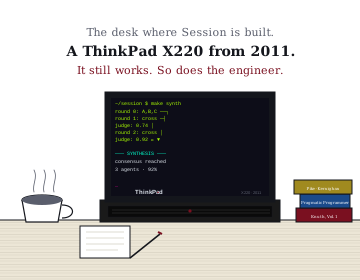
I administrate and manage this entire project from a ThinkPad X220 from 2011. Yes, really. It is older than half the developers reading this. It has been opened, cleaned, re-pasted, rebatteried, and re-keyboarded more times than I can count. The keyboard is the last great IBM-style chiclet that Lenovo ever made and I will fight people about it. The screen has a 1366x768 IPS panel I installed myself in 2015. The CPU is a Sandy Bridge i7. It is slow by modern standards. It is fast enough for the work that matters: writing code, writing prose, ssh-ing into the production box, reading. The retro-tech crowd will know exactly what I mean.
The lesson is not "old hardware is better". The lesson is that the tools you reach for every day should fit your hand. They should be repairable, ownable, knowable. The X220 is mine in a way that no sealed-bottom unibody laptop will ever be. When something is yours, you take care of it, and it lasts. The same is true of code, of an idea, of a community.
Session is a community first, an academy second, a tool third. The community is what gives the lexicon teeth. The academy is what gives the community a shared vocabulary. The tool is what makes the academy's lessons concrete. None of these works without the others, and none of them works without you.
Free account. Read the blog. Argue with me in the community room. Send a correction when I am wrong. Submit a lexicon entry. Bring your students. Bring your tools. Bring the kind of stubborn curiosity that made the open web a beautiful thing in the 1990s. That is the spirit this whole project is trying to recover.
One essay every week or two. Long-form, technical, opinionated, no marketing voice. I would rather be useful to fifty engineers than "engaging" to fifty thousand. If you find an error, please mail me at hello@session.ad. I edit published posts when corrections come in, and I credit the corrector. That is the deal.
A foundational essay on why a single confident answer hides the disagreement that hard questions deserve, and why putting several models in the same room is the smallest fix.
How a multi-agent debate is actually structured: parallel fan-out, round-robin critique, a small judge, threshold exit, and a synthesizer that preserves minority dissent.
A hands-on guide to running three local models in a debate on your own machine. Hardware math, model selection, latency, and when to reach for the cloud.
Why an AI app that stores your model-provider keys server-side is a liability waiting to be discovered. The OS keychain is the only defensible default.
An agent that can only talk is a chatbot. The Model Context Protocol turns 'AI assistant' from a chat metaphor into something that reads files, runs tests, and opens pull requests.
The world is loud. Most of what passes for "content" online is designed to take from you, your attention, your time, your patience, and give you a brief feeling in return. This site is the opposite of that. Every essay here is meant to leave you smarter than it found you. Every lexicon entry is meant to give you a word you did not have. Every lesson is meant to give you a hand-hold, not a hand-out.
If you walk away from one of my posts annoyed, that is fine. If you walk away unchanged, I have failed. If you walk away thinking, I have done my job. Bookmark this site. Come back when the day is loud and you need a quiet place to think. I will keep writing it as long as you keep reading it.
E-mail: hello@session.ad. I read everything. I reply when there is something useful to add. The community room is the better place for general questions. E-mail is for things you would rather keep off the public record.
